Ink-saving
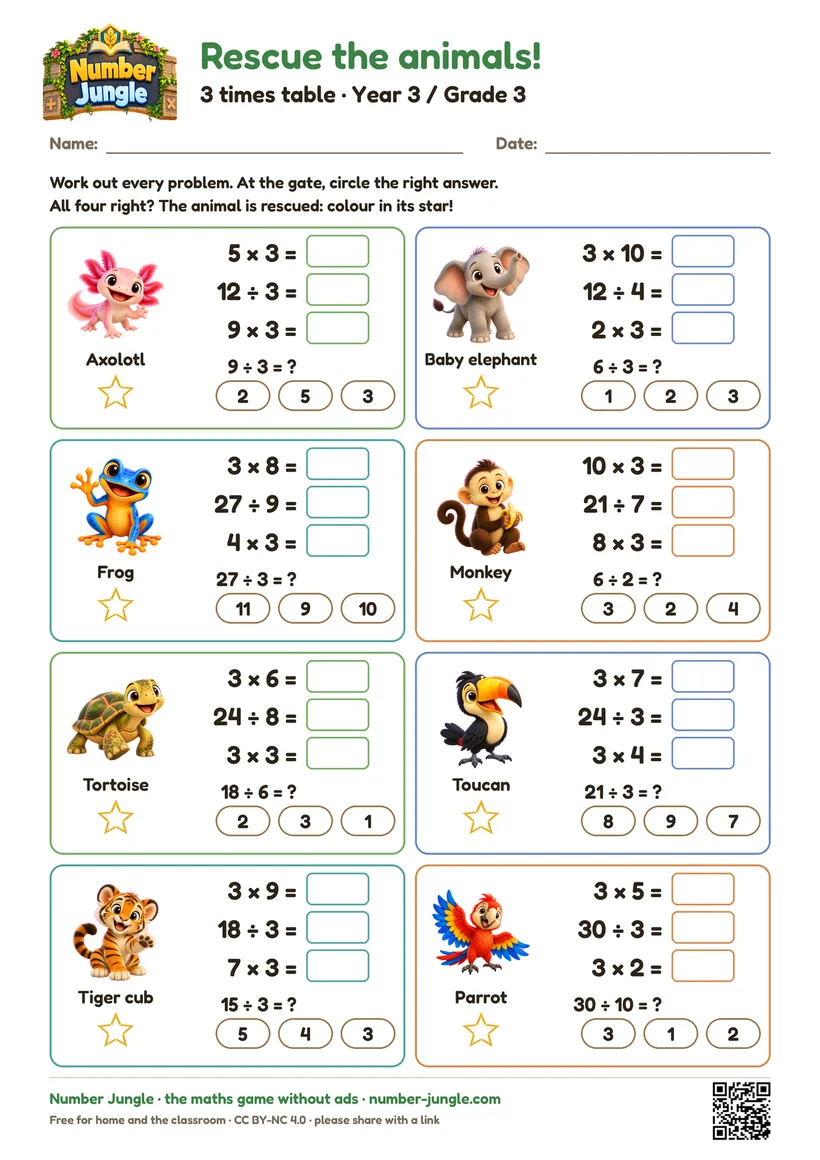
White cards with coloured borders and the animals in colour. For every animal rescued, your child colours in a star.
Download PDFChildren usually learn the 3 times table in Year 3 in the UK and in Grade 3 in the US. It is the first table without an obvious pattern, so it is usually the first one that needs real practice. Below are the facts from 3 × 1 to 3 × 12, the tricks that make them stick, the mistakes to watch for, and two things to print: a worksheet with 32 problems (multiplication both ways round and the matching division facts, with eight animals to rescue) and a poster of the table in its colour from the multiplication chart. Free, no sign-up.
White cards with coloured borders and the animals in colour. For every animal rescued, your child colours in a star.
Download PDF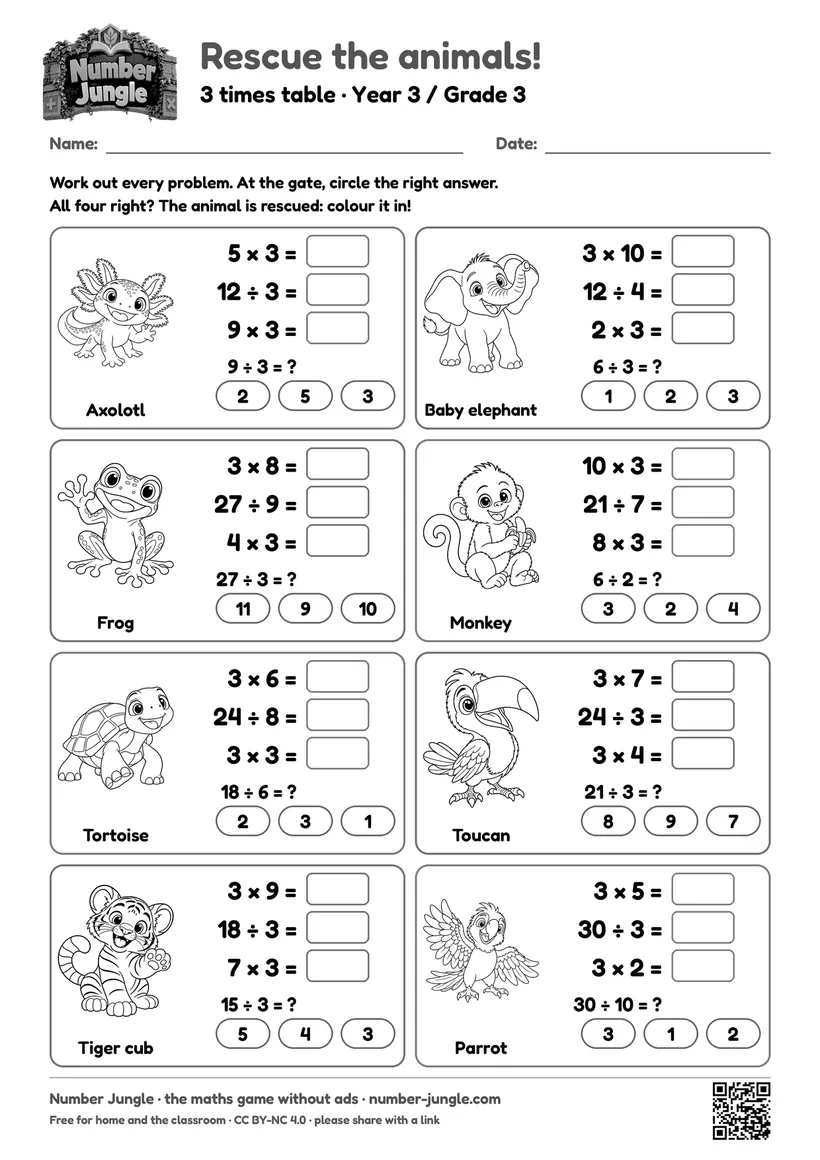
Black and white for any printer. Once an animal is rescued, your child gets to colour it in.
Download PDF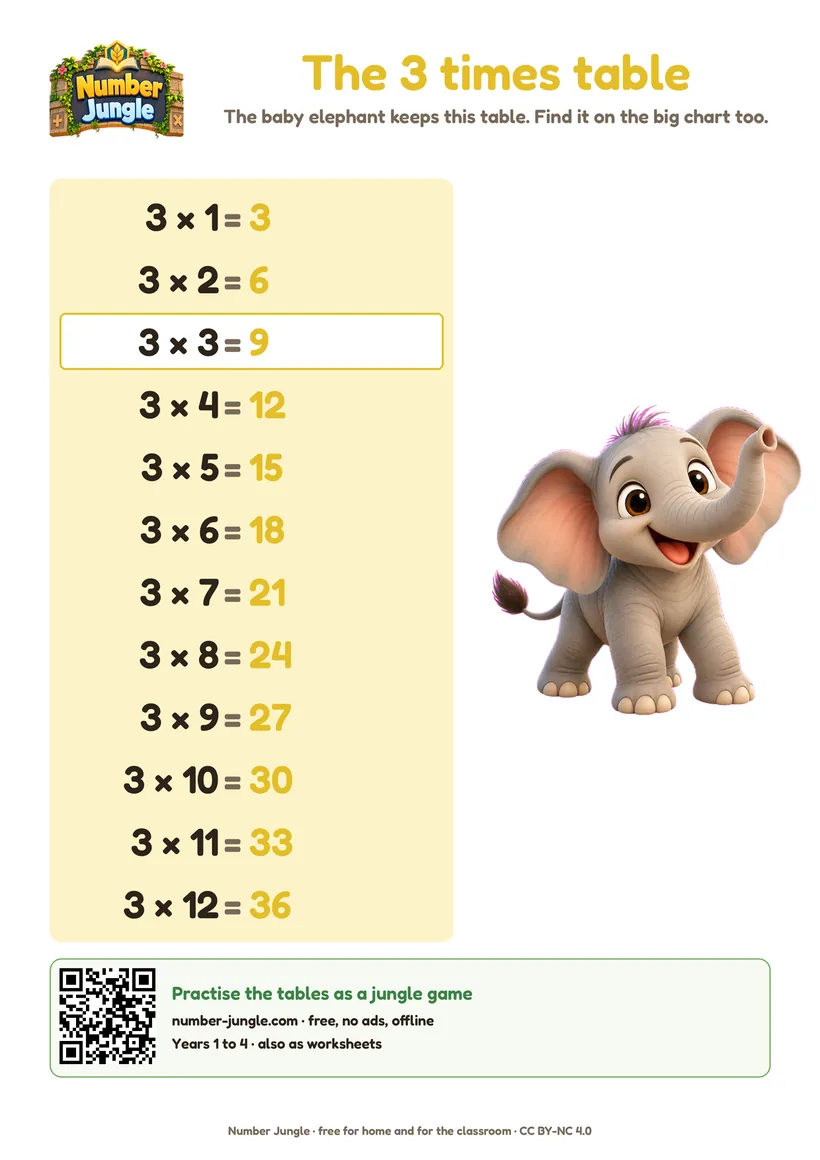
The 3 times table from 3 × 1 to 3 × 12 in big type, in its colour from the multiplication chart, with the baby elephant that keeps it. For the wall or the fridge.
Download PDFFree for home and the classroom. Licence: CC BY-NC 4.0, so feel free to print, copy and pass it on, just don't sell it. If you share the sheet online, please link to this page. CC BY-NC 4.0
Once the 3s are secure, the 6 times table is the 3s doubled, and the 9s are the 3s tripled. All twelve tables at once are on the multiplication chart, and the Multiplication Tables Check practice sheets test the 2 to 12 tables in the format of the Year 4 check.
Skip counting out loud, with a clap on every third number, gets the sequence into the ear first.
Three times a number is two times it (doubling) plus the number once more.
Add the digits of any answer and you get 3, 6 or 9. A quick check for an answer your child is unsure of.
The answers alternate odd and even. 3 × 7 must be odd, so 22 cannot be right.
21 ÷ 3 asks: how many 3s fit into 21? The worksheet practises both directions.
The answers in the twenties get mixed up.
What helps: 3 × 7 is odd (21), 3 × 8 is even (24).
Jumping to a neighbouring fact.
What helps: Anchor on 3 × 5 = 15: one more three is 18, three more is 27 (via 3 × 10 = 30 − 3).
Adding 3 + 4 instead of multiplying.
What helps: Three fours: 4, 8, 12.
The sheet works well as independent practice, homework or an extension task for early finishers; the poster goes on the wall next to the full multiplication chart so the class can see where the 3s sit. The colouring version prints on any black-and-white photocopier, and the ink-saving version needs very little colour.
In Number Jungle your child runs through the jungle and dashes through the gate with the right answer. The same problems, matched to their school year, with no ads and offline. Free for Android, iPhone and iPad.
More about the game →In Year 3 in England (the national curriculum) and in Grade 3 in the US, after the 2s, 5s and 10s are secure. In England all tables to 12 are checked at the end of Year 4.
9. It is the square number of this table, shown in a white box on the chart and on the worksheet poster.
Yes. It is free, with no sign-up and no email address. You may print and copy it for home and for the classroom (CC BY-NC 4.0).
No, on purpose. The swapped fact is a good check: if your child worked out 3 × 4 = 12, they can check it with 4 × 3. For the gate problems, the right answer is one of the choices anyway.
The ink-saving version has animals in colour and a star to colour in. The colouring version is completely black and white, and the rescued animal itself gets coloured in.
Short, frequent practice helps most: a few minutes a day beats one long session. The free game Number Jungle asks the facts that are still wobbly more often until they stick, and the poster on the wall is there for a quick look-up in between.