Practice form 1
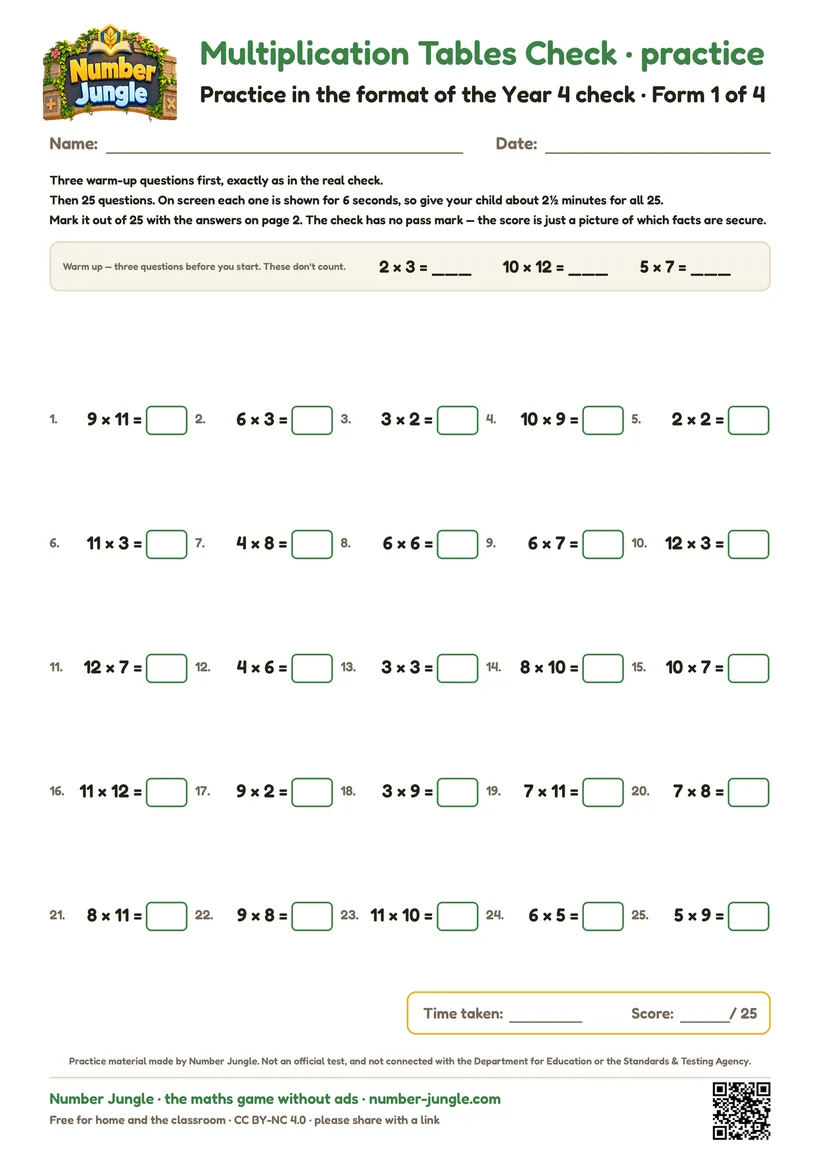
25 questions in the format of the check, three warm-ups, answers on page 2.
Download PDFChildren in Year 4 at state schools in England take the Multiplication Tables Check in a window in June. It is 25 questions on a screen, each one n × n, with 6 seconds to answer each. These four free practice sheets are built to the same recipe: 25 questions drawn from the 2 to 12 times tables in the proportions the official assessment framework sets out, three warm-up questions first, and an answer page so you can mark it out of 25. There is no pass mark in the check, and there is none here — the score only shows which tables are secure and which still need a bit of practice. Print them as PDFs, no sign-up needed.
25 questions in the format of the check, three warm-ups, answers on page 2.
Download PDF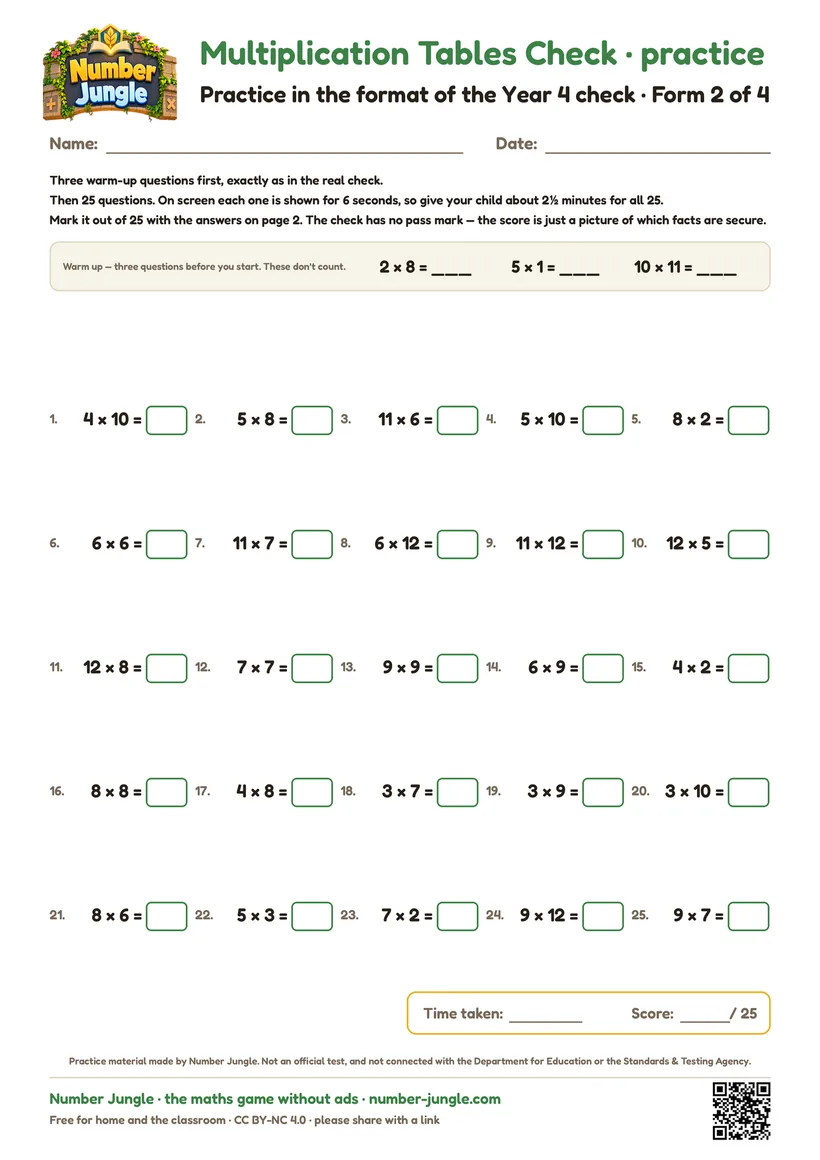
A different 25 questions — no more than 7 of them appear in any other form.
Download PDF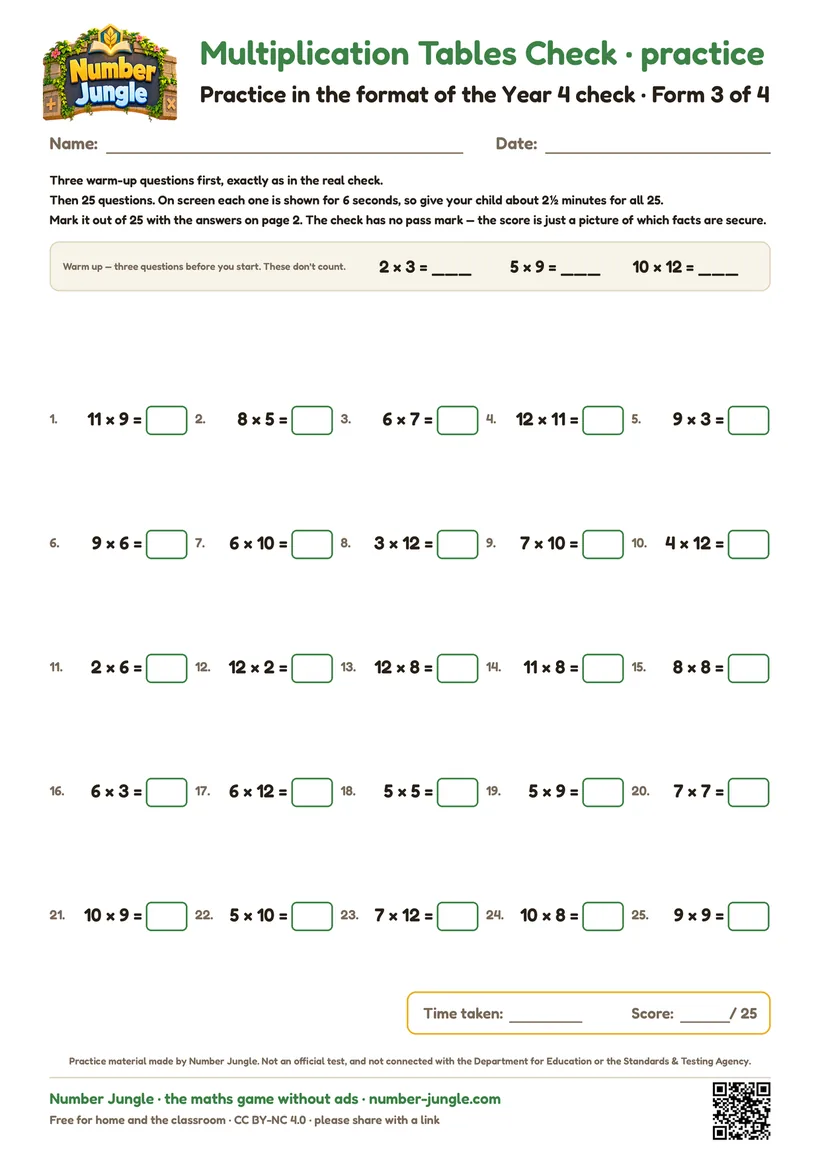
A third set, for later in the term.
Download PDF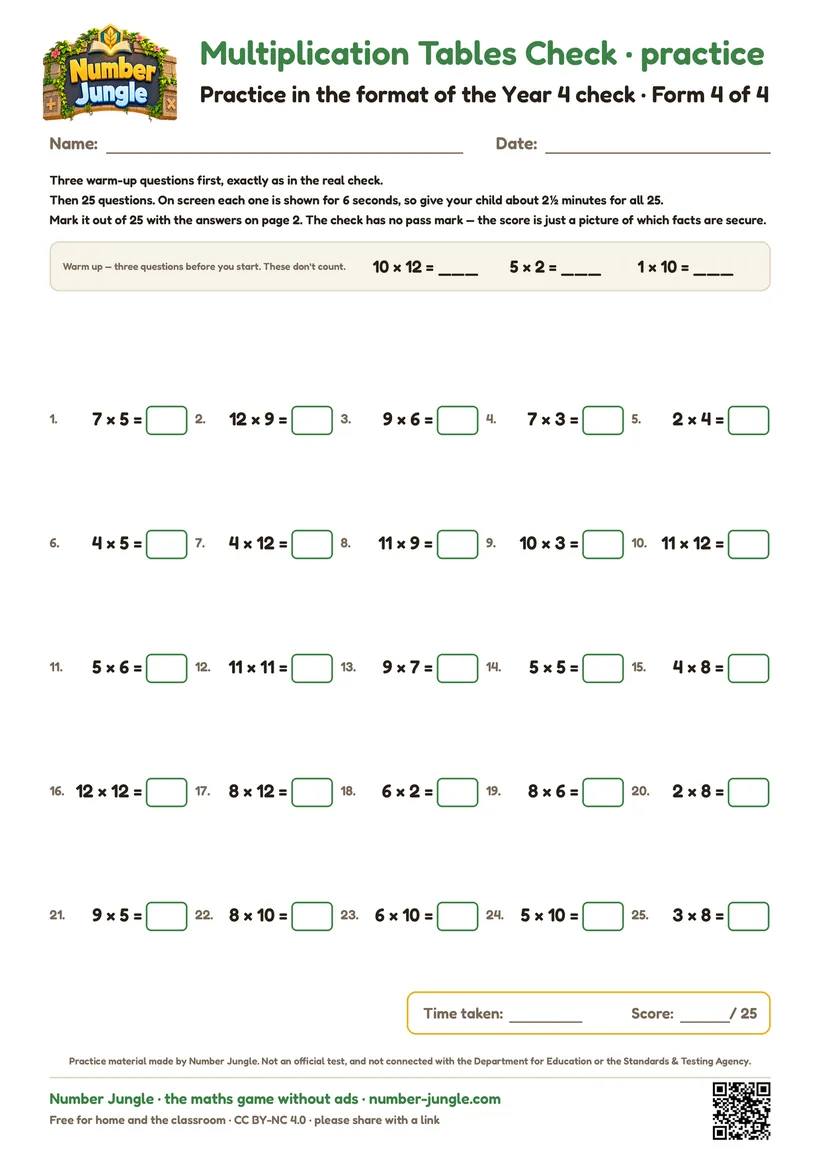
The last of the four, for the weeks before the check.
Download PDFFree for home and the classroom. Licence: CC BY-NC 4.0, so feel free to print, copy and pass it on, just don't sell it. If you share the sheet online, please link to this page. CC BY-NC 4.0
Learning one table at a time? The 7 times table worksheet has tricks and 32 problems for that one table.
Times tables stick through short, frequent practice. One sheet a half-term, and a couple of minutes in the car, will do more than a long session the week before.
Every fact and its swap have the same answer, so learning one teaches both. The pile is about half as big as it looks.
Most children have the 2, 5 and 10 tables early. Everything else can be reached from them: 6 × 7 is 5 × 7 and one more 7.
Six seconds is enough to recall a fact and not enough to work it out. So practise until a fact is known, rather than practising going faster. A child who counts up in 7s is not slow, they just haven’t finished learning it yet.
The answer page is the point of these sheets. Three wrong out of 25 in the same table tells you exactly what to spend next week on; a score alone tells you very little.
Children pick up quickly when a grown-up is worried about something. The check is five minutes in June and there is no pass mark; a sheet at the kitchen table is just a sheet at the kitchen table.
The two most-missed facts in the whole grid, and children often swap their answers.
What helps: “5, 6, 7, 8” → 56 = 7 × 8. And 6 × 7 is double 3 × 7.
The 9s look alike and come late in the learning.
What helps: The digits of every answer in the 9 times table add to 9: 6+3, 7+2. And 9 × 8 is 10 × 8 minus 8.
The 11 and 12 tables are the newest, and both are in the check.
What helps: 12 × is 10 × plus 2 ×: 12 × 12 = 120 + 24. Above 10, the 11 times table stops being “just double digits”.
Next-door answers, so a near miss looks right.
What helps: 7 × 7 is odd × odd, so it has to end in an odd digit — 48 can’t be it. 6 × 8 is double 3 × 8.
The four forms are built to the published item-selection rules, so they can stand in for a mock: 25 items with each table inside its minimum and maximum, 3 to 7 items from the Key Stage 1 tables, no repeats and no reversals within a form, and no more than 30 % of items shared between any two forms. That last rule is why there are four and not one — a class can sit them across the spring term without recognising the questions. They print on any black-and-white photocopier. The answers are on page 2, so print page 1 only for the children.
In Number Jungle your child runs through the jungle and dashes through the gate with the right answer. It drills the times tables up to 10 × 10 — most of what the check asks, but not the 11 and 12 tables, which these sheets cover. No ads, works offline, free for Android, iPhone and iPad.
More about the game →An online check of the 2 to 12 times tables, taken by every Year 4 child at a state-funded school in England. 25 questions, 6 seconds each, about five minutes in all.
In a window in June, on a day the school chooses. In 2026 the window ran from 1 to 12 June, with a catch-up week after it. The dates for later years are published by the government each year.
No. There is no pass mark and no expected standard. The school gets a score out of 25 and reports it to parents.
There is no official answer to that, because there is no pass mark. For context: in 2025 the average in England was 21 out of 25 and 37 % of children scored 25. It is a useful picture of which facts are secure, not a grade.
No. The Multiplication Tables Check is for England. The other UK nations do not run it.
It is statutory for state-funded schools in England. A headteacher can decide that a particular pupil should not take it. If you think that applies to your child, the school is the place to ask.
The government’s own guidance for parents says you do not need to do anything additional to prepare your child for the check. These sheets are here for families who would like to practise anyway, or who want to see which tables are still wobbly.
No. These are practice sheets made by Number Jungle, printed on paper, built to the published format. They are not an official test and we have no connection with the Department for Education or the Standards & Testing Agency.
Yes, on page 2 of each PDF. It is the only sheet on this site with one: the check is marked out of 25, so a sheet without answers would miss the point.
Yes, with no sign-up and no email address. You may print and copy the sheets for home and for the classroom.